
How HTML Was Created: The Story Behind the Web
How HTML started: Tim Berners-Lee, CERN, the first website, and how a simple markup language became the foundation of the modern web.
 RazakTerra
- Reading time
- 5 min read
- Comments
- Discussion
On this page
Imagine a world without websites. No Google, Instagram, YouTube, or even online stores. Information would be scattered across different computers, difficult to find, and barely connected to each other.
That was basically the problem scientists at CERN (the European Organization for Nuclear Research) in Geneva, Switzerland, were dealing with in the late 1980s. And from that very practical problem came HTML the language that would eventually become the backbone of the web.
Who Created HTML?
HTML was created by Sir Timothy John Berners Lee, better known as Tim Berners Lee, a British computer scientist born on June 8, 1955.
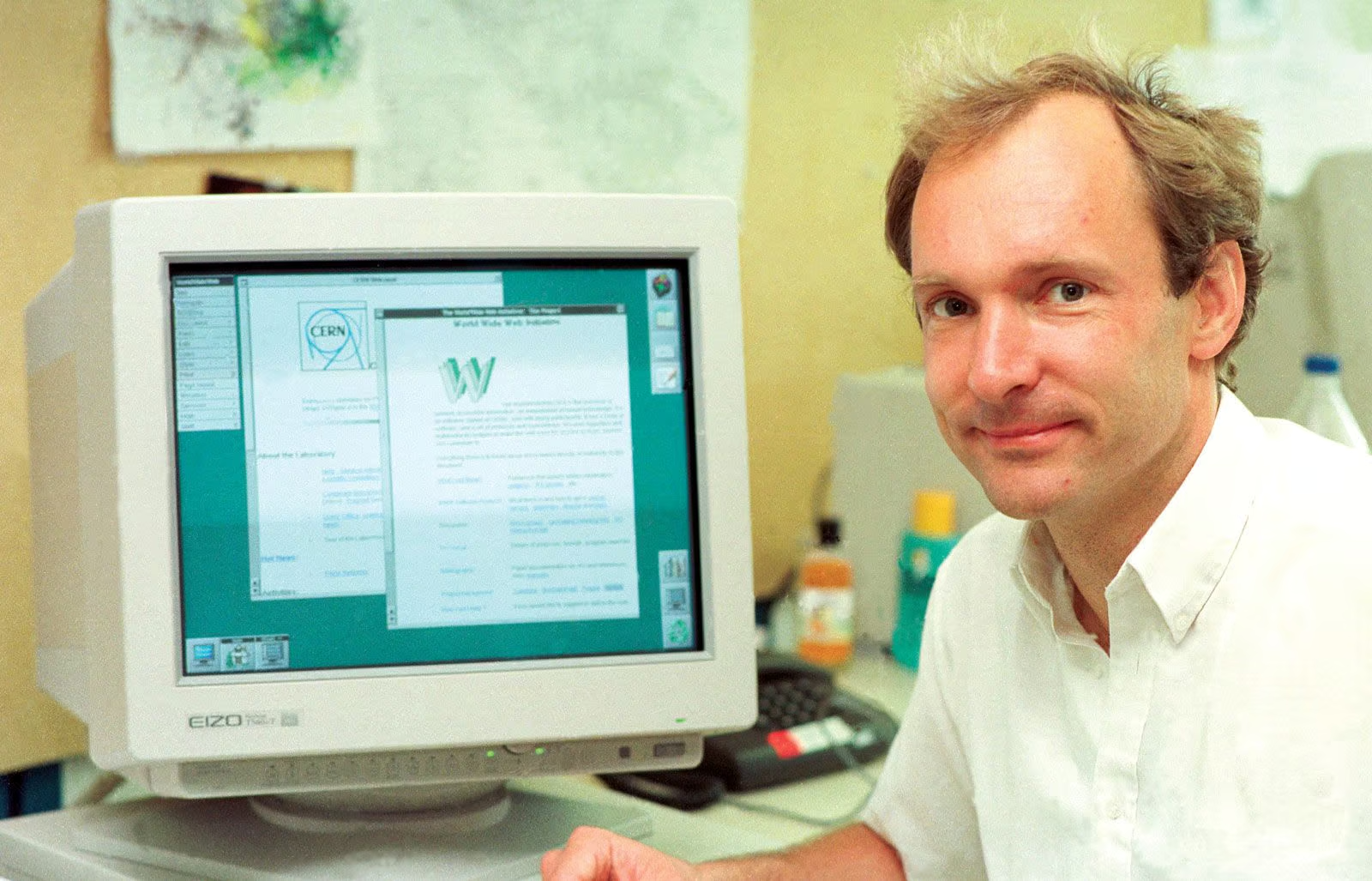
At the time, Berners Lee was working at CERN, first as a consultant and later as a staff member. He didn’t work completely alone. He was helped by several colleagues, most notably Robert Cailliau, a Belgian systems engineer, as well as people like Nicola Pellow, who worked on the line mode browser.
Still, the original idea and early implementation of HTML, along with the World Wide Web (WWW), HTTP, and URLs, came from Berners Lee. That’s why he’s often called the “father of the World Wide Web.”
How It Started: The Problem at CERN (1980–1989)
Back in 1980, Berners Lee created a simple program called ENQUIRE.
The program allowed documents to be connected through links, or what we now call hypertext. Think of it as a collection of digital notes that could reference and connect to one another.
The idea was pretty simple: make it easier for CERN scientists to share research information that was scattered across different computers and systems that didn’t always work well together.
The problem was that ENQUIRE was still a local system.
Then, in March 1989, Berners Lee wrote a proposal called “Information Management: A Proposal.” He suggested creating a distributed information system based on hypertext that could be accessed over the internet.
His boss famously described the proposal as “vague, but exciting.”
A more formal version of the idea was later developed with Robert Cailliau in November 1990 under the project name WorldWideWeb.
The Birth of HTML (1990–1991)
By the end of 1990, Berners-Lee had built the three main foundations of the web:
- HTML (HyperText Markup Language) a language for structuring documents.
- HTTP (HyperText Transfer Protocol) the protocol used to transfer those documents.
- URL (Uniform Resource Locator) a unique address for each resource.
HTML was created as a simplified version of SGML (Standard Generalized Markup Language), an existing markup language.
But Berners Lee added something that would become incredibly important: the anchor tag, <a>, which allowed documents to link to one another.
Without links, there probably wouldn’t be a “web” in the first place.
The first web browser also called WorldWideWeb, and later renamed Nexus and the first web server (info.cern.ch) ran on a NeXT computer in Berners Lee’s office.
The computer even had a red label that said:
“This machine is a server. DO NOT POWER IT DOWN!!”
The first website went live on December 20, 1990:
It was basically a page explaining the World Wide Web project itself.
In 1991, the software was released to the public, and the web slowly began spreading beyond CERN.
The Evolution of HTML: From Simple to Powerful
The earliest version of HTML was extremely simple, with only around 18 tags.
Here’s how it evolved:
- Early HTML / “HTML Tags” (1991) Berners-Lee’s early documentation describing the basic HTML tags.
- HTML 2.0 (1995) The first official HTML standard (RFC 1866). It introduced features such as forms and tables.
- HTML 3.2 (1997) Released by the W3C, with better support for tables, applets, and page layout.
- HTML 4.01 (1999) Became one of the most widely used versions of HTML. It encouraged separating document structure from presentation through CSS and added better support for accessibility and scripting.
- XHTML (2000s) A stricter version of HTML based on XML rules.
- HTML5 (2008 draft, official recommendation in 2014) A major step forward. It introduced semantic elements like
<header>,<nav>,<article>, and<footer>, native audio and video through<audio>and<video>,<canvas>, and APIs for modern web applications.
Today, HTML is maintained as a Living Standard, continuously evolving through the work of WHATWG and the broader web standards community.
Why Was HTML So Revolutionary?
HTML isn’t a programming language. It’s a markup language.
Its job is to give content structure and meaning so that browsers know how to display it.
What made HTML so powerful was its:
- Simplicity Anyone could create a web page using plain text.
- Open and royalty-free nature CERN released the web software on a royalty-free basis in 1993.
- Universal linking A single click could take you to information anywhere in the world.
- Flexibility What started as a way to share simple scientific documents eventually became the foundation for complex web applications like YouTube, Google Docs, and countless others.
Without HTML, the web as we know it simply wouldn’t exist.
It made it possible for information to flow freely, helped democratize access to knowledge, and changed the way people communicate, shop, learn, and work.
The Legacy That Is Still Alive Today
What started as a proposal in a particle physics laboratory eventually became the language behind billions of web pages.
In 1994, Tim Berners Lee founded the World Wide Web Consortium (W3C) to help keep web standards open and universal.
Today, every time you open a browser and read an article like this, you’re using a direct descendant of an idea Berners Lee came up with more than 35 years ago.
HTML has changed a lot since then, but its original purpose remains surprisingly simple:
to make information connectable and accessible to everyone, anywhere.
And that’s the story behind HTML a relatively simple markup language that ended up changing the world.
Written by
Razak
Writes about the web, slowly, and builds small tools on the side.
Keep reading
Read next
 1 min
Best Practices for Writing Clean and Valid HTML
A collection of HTML best practices including proper indentation, naming, W3C validation, and common beginner mistakes you should avoid.
Read article 2 min
Getting to Know HTML Iframe: How to Embed YouTube and Google Maps
How to use the HTML <iframe> tag to embed content from other sites, like a YouTube video or a Google Map, inside your own page.
Read article 1 min
How to Create Forms in HTML for Beginners
A beginner's guide to HTML forms: how the <form> tag sends data for logins, sign-ups and contact messages, starting from the basics.
Read article
Discussion
Comments
Loading comments…