
Octoverse 2026: Commits Hit Record Highs as Developers Build with Agents
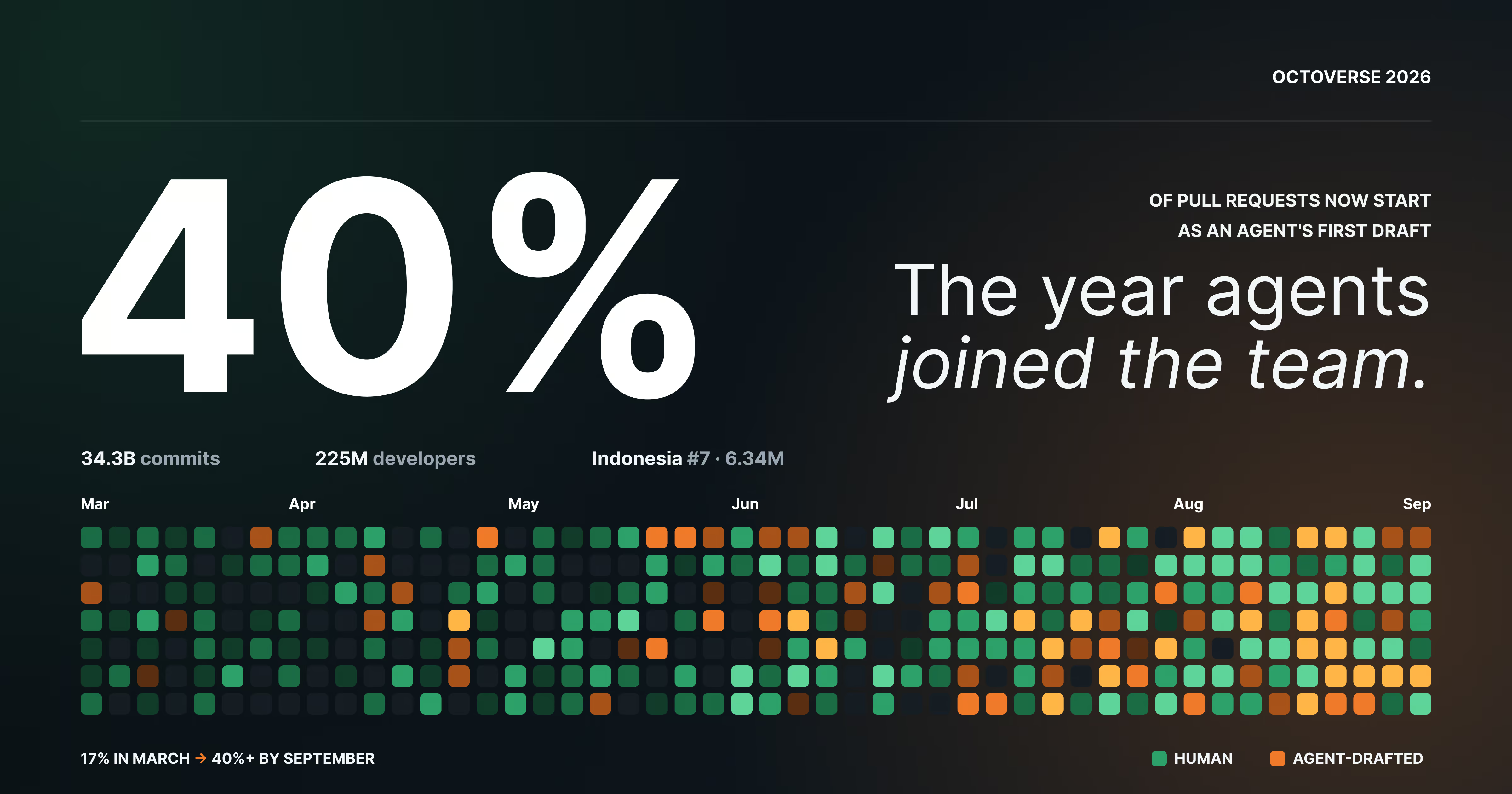
GitHub's Octoverse 2026 counted 34.3 billion commits and found that over 40% of pull requests now start as an agent's draft. Here is what the numbers mean, and what they mean for you as a developer.
 RazakTerra
- Reading time
- 9 min read
- Comments
- Discussion
On this page
- The short version
- The activity numbers are huge
- Where agents show up in the data
- Repositories with an agent file are much busier
- Four in ten pull requests start with an agent
- Copilot users are going agentic
- Developers mix and match models
- TypeScript, Python and a Rust surprise
- Where the 225 million developers are
- It’s not just tech companies anymore
- So what does this mean for you?
Every year GitHub opens its books and tells us what developers did with their platform. Usually the story is “a bit more of everything”: more repositories, more contributors, a language swapping places with another one. You skim it, you nod, you move on.
The Octoverse 2026 report, published on October 28, is not that kind of year. Developers pushed more code in twelve months than in the two previous years combined. And the reason is not that millions of people suddenly started typing faster. In this post we’ll walk through the headline numbers, look at where AI agents show up in them, check which languages and countries are growing, and finish with what all of it means for the way you work.
The short version
If you only remember one thing, make it this: people still decide what gets built, but more and more of the first draft is written by an agent.
Almost every number below is a variation on that sentence. Volume went up because agents produce a lot of commits. Review and automation went up because someone (or something) has to check all that output. And the developer’s job slowly shifts from typing the code to describing it, reviewing it, and deciding whether it is any good.
The activity numbers are huge
Let’s start with raw volume. These are the totals for the twelve months ending September 30, 2026:
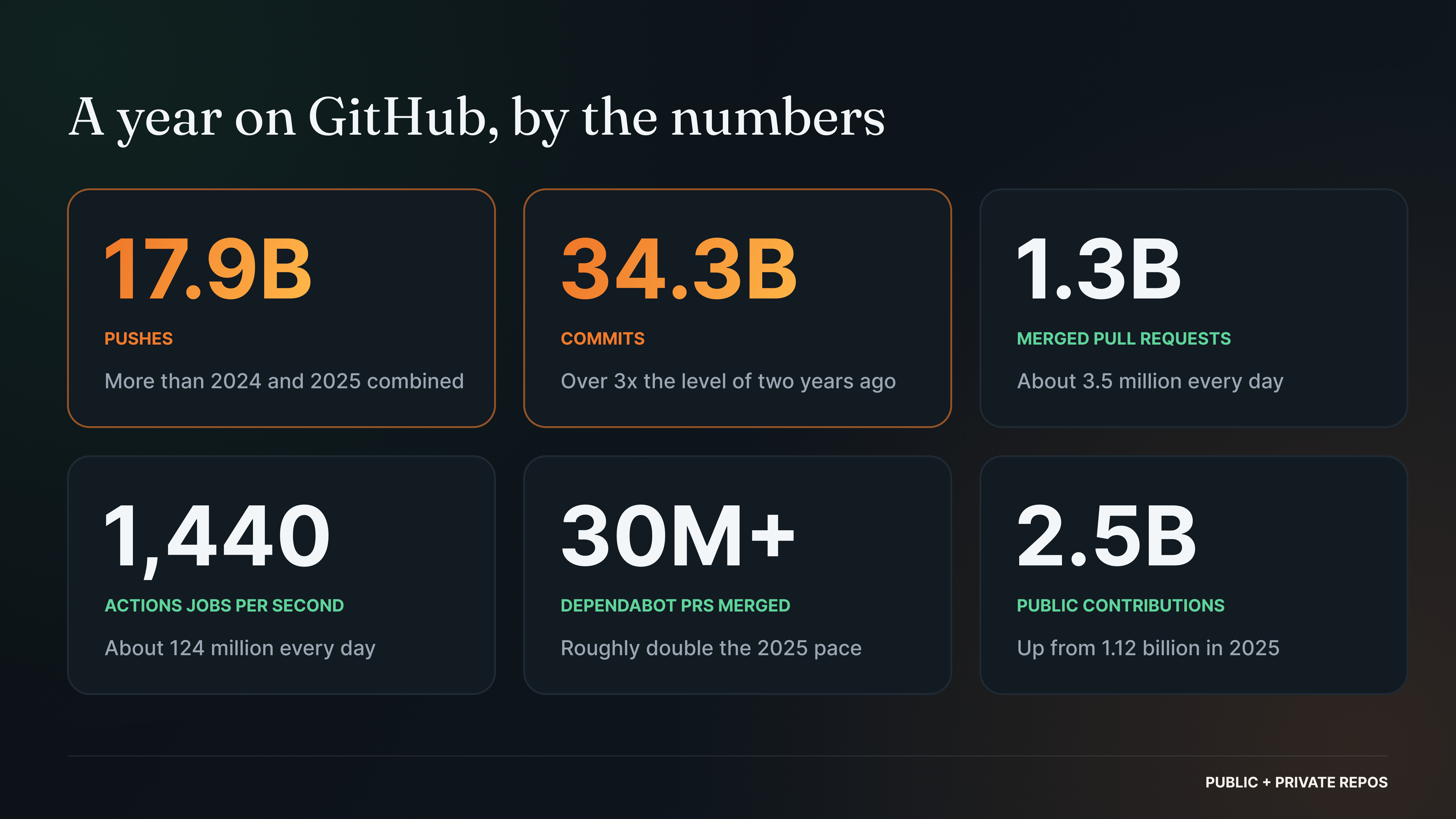
Two of those deserve a second look.
Commits tripled in two years. Developer headcount did not triple, so each developer (or each developer plus their tools) is producing a lot more commits. A commit is cheap for an agent. It can make ten small ones while you are still reading the diff of the first.
Actions and Dependabot grew alongside. 1,440 CI jobs per second is what happens when code arrives faster than humans can check it by hand. Tests, linters and dependency updates are the safety net, and the net is getting much bigger.
Where agents show up in the data
This is the part of the report that changes the story. GitHub tracked “agent signals”: a configuration file that sets up a coding agent in a repository, or a pull request whose first draft came from a detectable agent.
Repositories with an agent file are much busier
Among repositories created in 2026, the ones with an agent configuration file averaged eight times as many commits as the ones without.
It’s tempting to read that as “add an agent file, get 8x productivity”. Don’t. Teams that bother to configure an agent are probably more active to begin with. What the number does tell you is that agent-driven repositories have a very different rhythm: lots of small, frequent commits instead of a few big ones.
Four in ten pull requests start with an agent
In March 2026, about 17% of pull requests started as an agent’s first draft. By September it was more than 40%. That’s not a slow trend line. That’s more than doubling in six months.
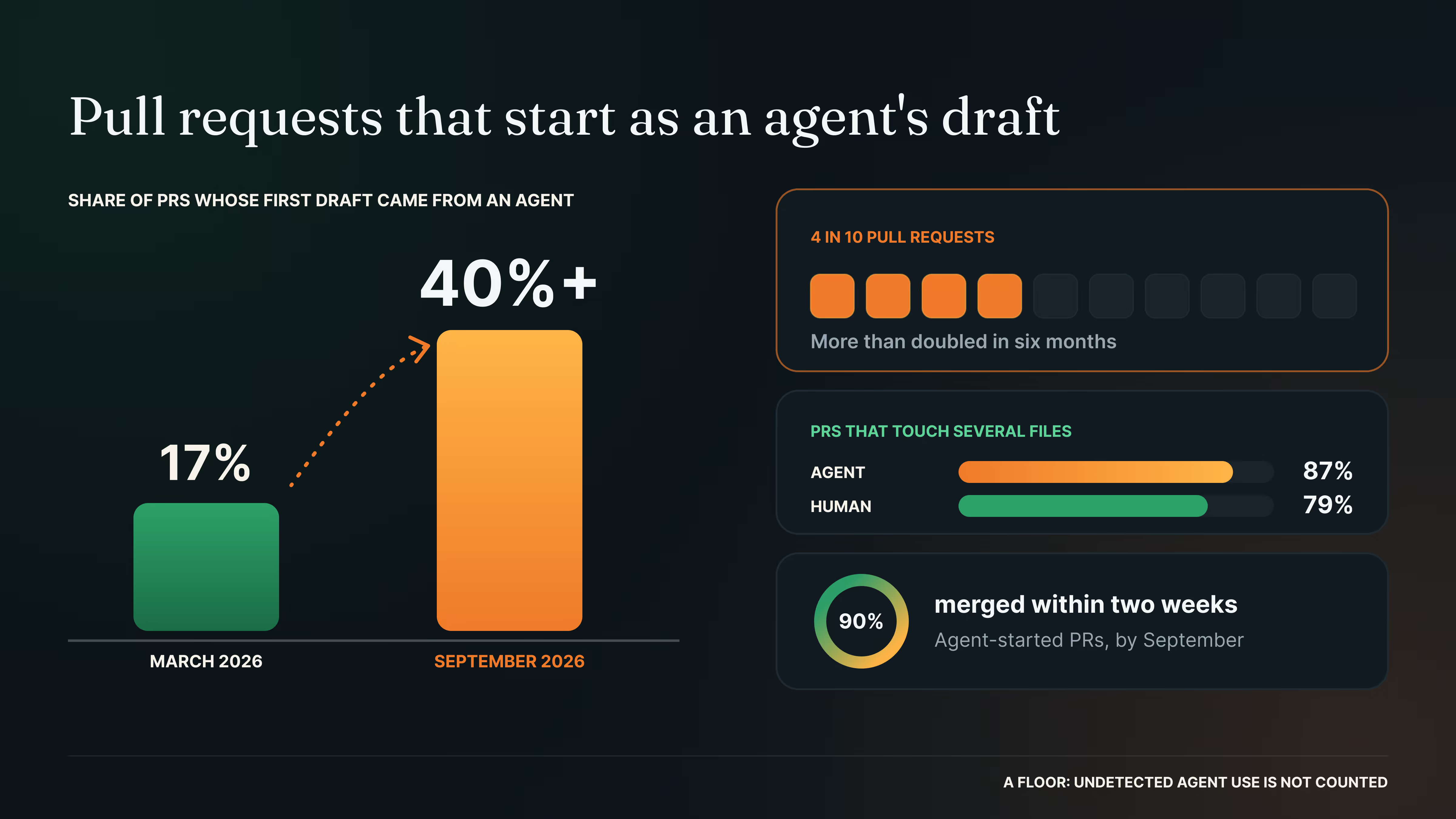
A few details make this more interesting:
- Agent-started pull requests touch multiple files more often than human-started ones (87% vs. 79%). Agents are not just fixing typos.
- By September, 90% of them were merged within two weeks. So they are not piling up as noise, people actually accept them.
- GitHub counts this as a floor: an agent that leaves no detectable trace isn’t counted, so the real share is likely higher.
Copilot users are going agentic
Inside Copilot, 55% of monthly active users now use agentic features, up from 35% a year earlier. Usage of the Copilot cloud agent (the one that works on a task in the background and comes back with a pull request) grew 230% year over year.
Developers mix and match models
Another quiet shift: developers no longer pick one model and stick with it.
- 61% of Copilot users who choose their own model used more than one.
- Paying users used 29 distinct models in May, and 47 in September.
- Of the requests where a developer picked the model, 38 in 100 went to general-purpose models, 37 to deep reasoning models, and 25 to fast, lightweight ones.
- 63% of paying users let Copilot pick the model automatically at least once in September.
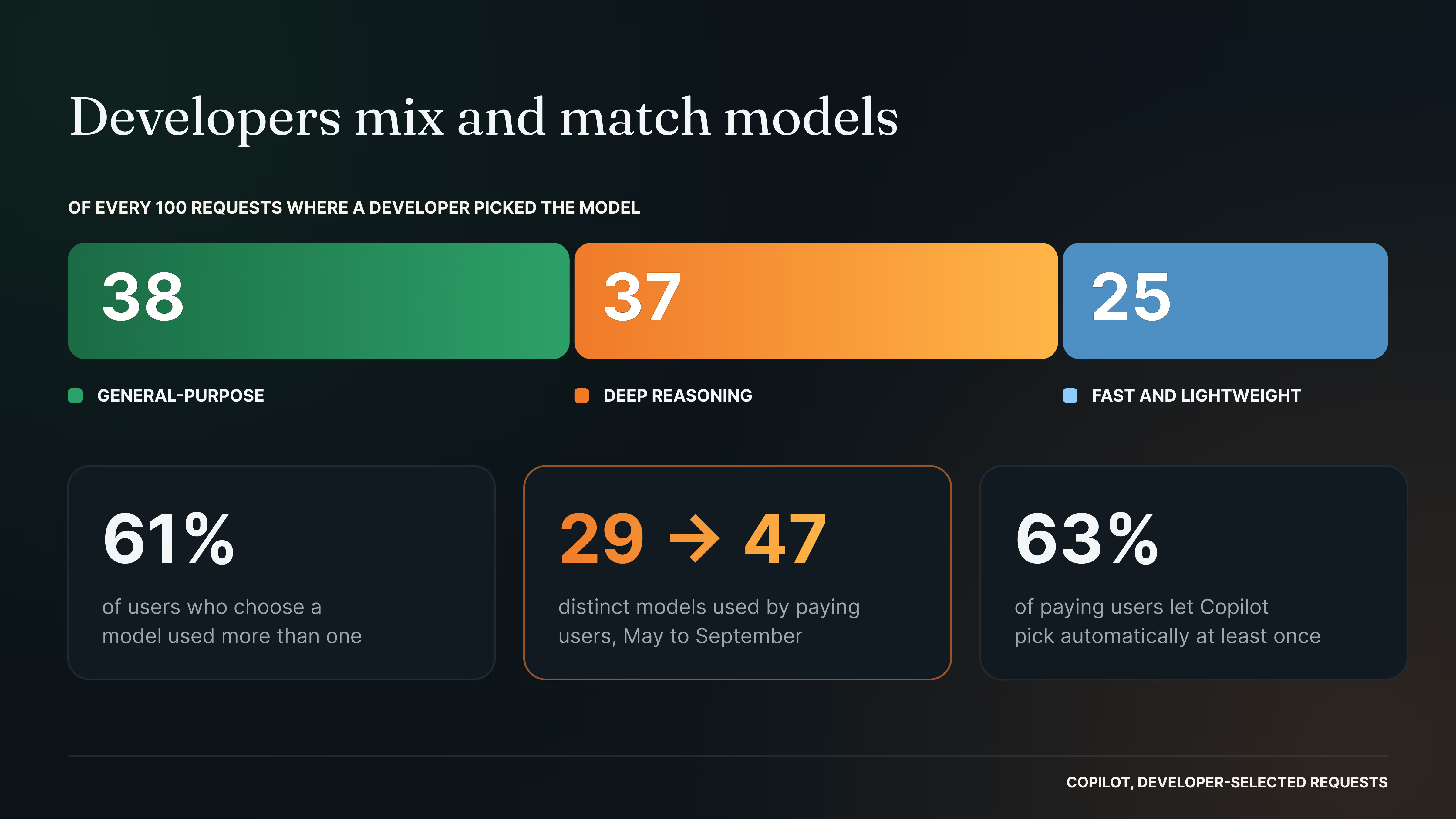
That split is a nice mental model on its own. A quick rename or a one-line fix goes to a fast model. A tricky bug or an architecture question goes to a reasoning model. Everything else lands in the middle. Choosing the model is becoming part of the craft, the same way choosing the right tool for a job always was.
TypeScript, Python and a Rust surprise
By number of contributors, the top three languages are TypeScript, Python and JavaScript. Here’s how many monthly contributors each one added between September 2025 and September 2026:
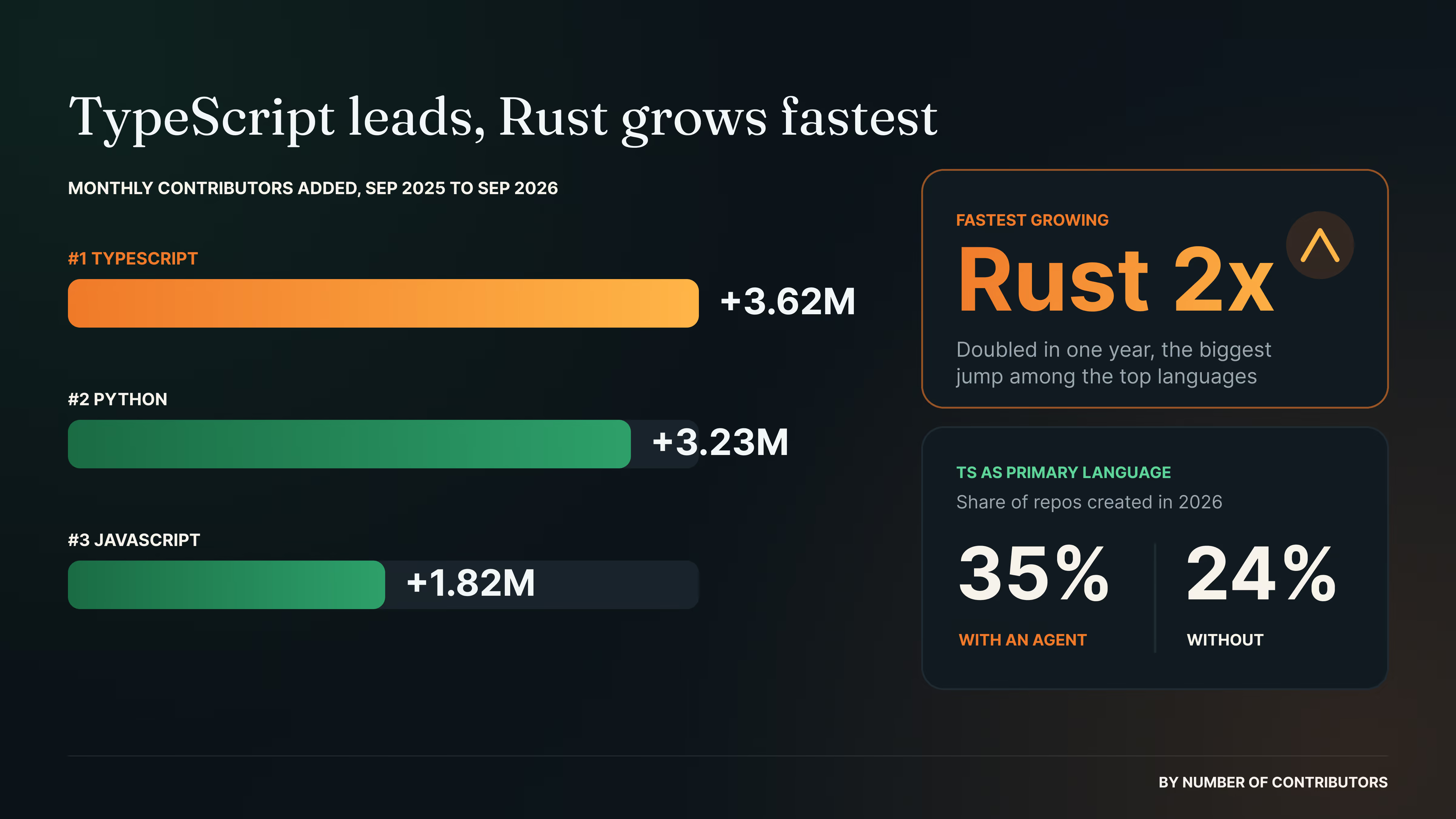
TypeScript on top is not a coincidence in an agent-heavy year. Among repositories created in 2026 with an agent signal, TypeScript was the primary language in 35% of them, compared with 24% of repositories without one. Types give an agent something to check its work against: if the compiler complains, the agent knows it got something wrong before a human ever looks. Python stays strong thanks to AI and data work, and JavaScript is still everywhere.
The surprise is Rust, the fastest-growing of the top languages by percentage. It doubled in a single year. Rust has the same appeal for agents as TypeScript, only stricter: if it compiles, a whole class of bugs is already ruled out.
Where the 225 million developers are
GitHub now has more than 225 million developers. Here are the ten biggest communities by country:
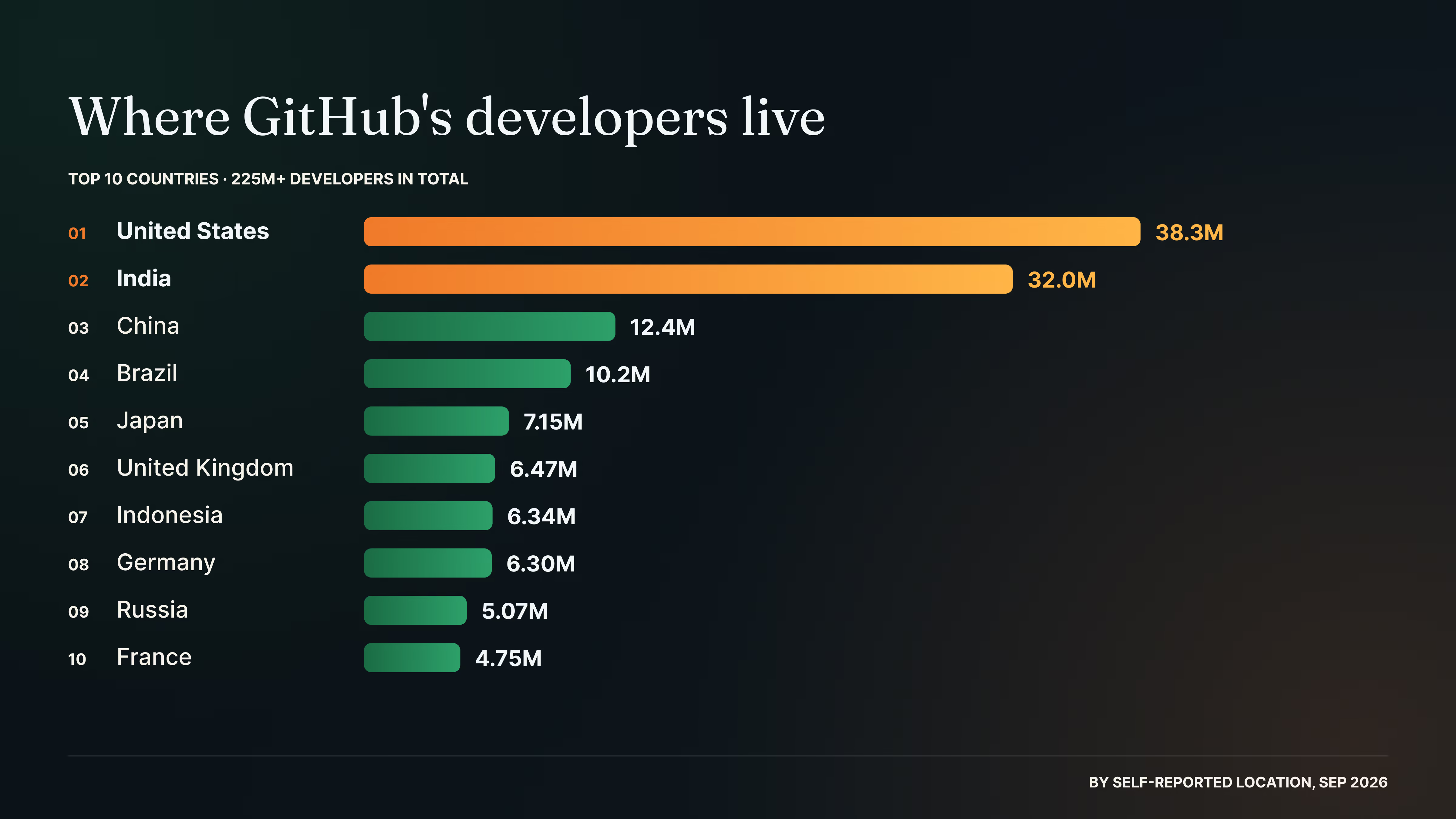
The United States and India are far ahead of everyone else, with more than 70 million developers between them. Below them the field is surprisingly tight: the United Kingdom, Indonesia and Germany are separated by less than 200,000 developers. Brazil is the one to watch. It added 3.28 million developers this year, the third most of any country.
Looking ahead, GitHub ran 43 forecasting models for 2031, and 21 of them project 3x or more growth. Forecasts are forecasts, but the direction is pretty clear.
It’s not just tech companies anymore
For the first time, the report sorted public repositories by industry (using the NAICS sector classification). Mining, health care, agriculture and administrative services have each grown several times over since 2022. Software is spreading into every corner of the economy, and so are the people who write it.
My favourite detail: construction has the highest share of agent-opened pull requests, at about 9%. An industry that is not famous for software is among the quickest to hand its first drafts to an agent. That makes sense when you think about it. If writing code isn’t your core job, an agent that writes the first version for you is worth a lot.
And yes, the report checked: the rocket emoji 🚀 is the most-used emoji in repositories across every single industry. Some things are universal.
So what does this mean for you?
GitHub credits the 2026 surge to three things: better models, better agent harnesses (the tooling around the model), and agents that keep working across days and run in the cloud. But the report also makes a point worth underlining: people still decide what to build and whether the result is good.
That is the skill that’s getting more valuable, not less. When the first draft is cheap, the expensive part is knowing what to ask for, spotting the subtle bug in a clean-looking diff, and saying “no, this isn’t right” with confidence. All of that comes from understanding the fundamentals. An agent can write you a pagination endpoint in seconds. Only you can tell whether it breaks on page 5.
If you want to get more out of this shift, here’s a short checklist:
- Add an agent configuration file to your project that explains how to build, test and style it.
- Give your agents something to check against: types, tests and a CI pipeline that runs on every pull request.
- Prefer small, focused tasks for agents, and review their pull requests as carefully as you would a colleague’s.
- Match the model to the task: a fast model for small edits, a reasoning model for hard problems.
- Keep learning the fundamentals. You can only review code you understand.
All figures in this post come from GitHub’s Octoverse 2026 report, which is worth a read in full.
Now go write something great, with or without an agent. 🚀
Written by
Razak
Writes about the web, slowly, and builds small tools on the side.
Keep reading
Read next
 3 min
Best Animated Icon Libraries for React That Actually Look Good
Four animated icon libraries for React that add smooth hover effects, pulses and micro-interactions without slowing your app down.
Read article 7 min
Best Image Converter Toolkits in 2026: Fast, Lossless Image Processing
Looking for the best image converter toolkits? Compare top tools like PackCamo, Squoosh, and CloudConvert for fast, high-quality, and secure image processing.
Read article 8 min
What Is Cache Storage? The Cache API Explained
Cache Storage keeps whole requests and responses in the browser. Learn the Cache API, how offline sites use it, and cache-first vs network-first, live.
Read article
Discussion
Comments
Loading comments…